
A Third Trip to See the Southern Cross
I am truly blessed to have so many opportunities in my lifetime to travel far enough South to observe the Southern Cross. This is my third trip south, meaning I’ve observed the Southern Cross three times. The first time was in Guatemala, the second time was in Hawaii, and now the third time is in Hawaii, once again. We are blessed by the Lord to provide us this incredible trip through my wife’s best friend and her husband. Hawaii is a lot more affordable when you have someone hosting you.
Given the time we have in Hawaii, I’ve been blessed to observe the Southern Cross for multiple nights. As I continue on my journey to explore the Southern Hemisphere night sky north of the equator, I keep noticing and learning new things which is exciting! When I was observing the Southern Cross at my favorite star gazing place in Oahu, I noticed over the ocean’s horizon the “Pointers” and the Southern Cross. Let me explain.

A photograph of the Southern Cross and the Pointers rising above the endless Pacific Ocean. The faint pink glow to the right is the Carina Nebula.
Navigating by the Stars
In the Northern Hemisphere, navigators and explorers would use the North Star as an anchor point to help them navigate. Because the North Star is located close to the North Celestial Pole, the North Star would stay stationary throughout the night while the other stars “move” across the sky, east to west. Likewise, the North Star would stay stationary throughout the whole year, even when different stars became visible or disappeared depending on the time of the year.
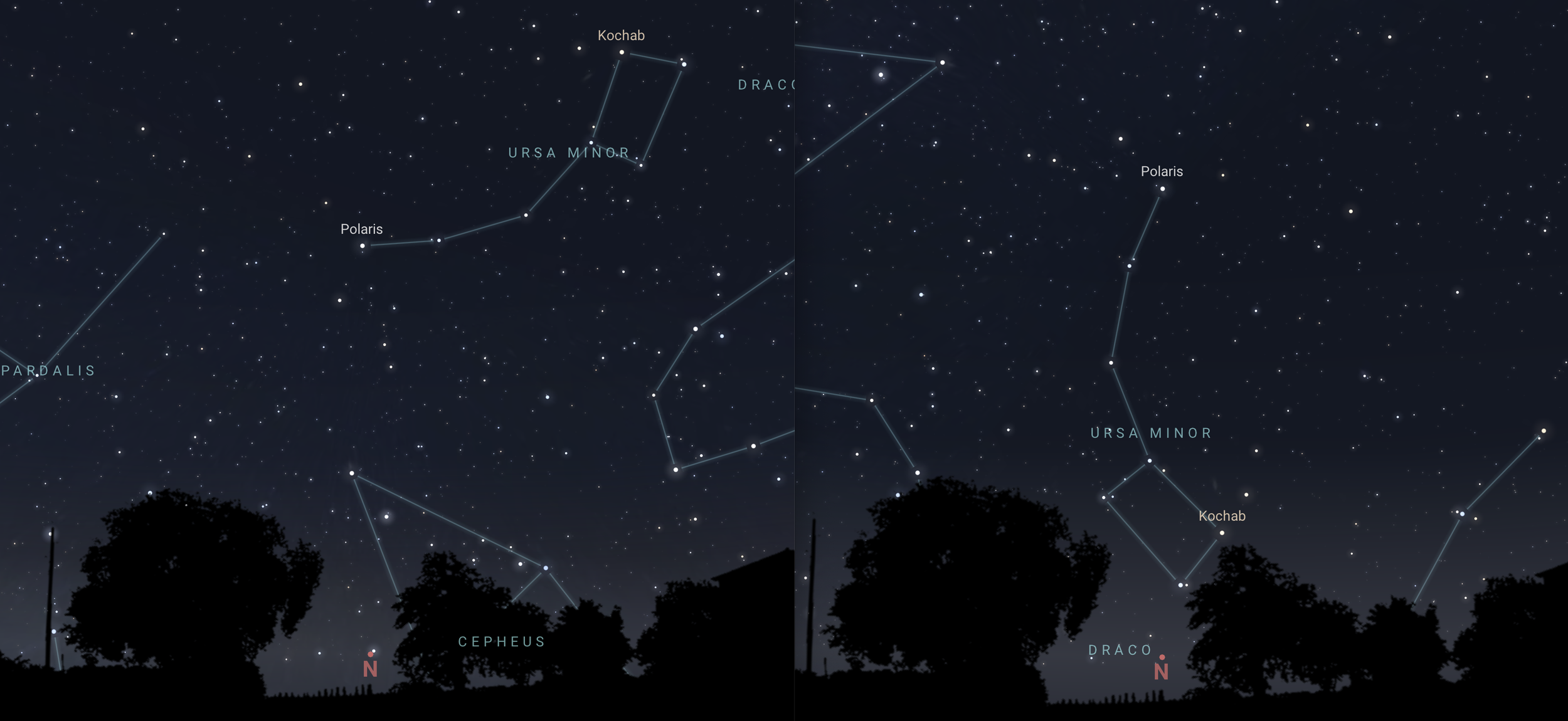
An example of the North Star (Polaris) being in the same position at 2 different times of the year. This is demonstrated through the webapp Stellairum.
In the image above, you can see that Polaris (the North Star) is sitting in roughly the exact same location along the horizon in the left picture and the right one. Even though the stars and constellations around Polaris are different, Polaris stays stationary. Hence, Polaris was a great tool to help navigators know which way was North, and then they were able to judge which directions were East, West, South, etc. using Polaris as a point of reference.
However, in the Southern Hemisphere, there is no pole star. In other words, the Southern Hemisphere navigators had to be more creative and understand the night sky a little bit more to find the location of the South Celestial Pole because it does not have a “South Star”. And, the North Star is not visible in the Southern Hemisphere because it is hidden by the sphere of the Earth.
Thus, navigators will use the Southern Cross and the Pointers.
The Southern Cross as a Guide
The Southern Cross is one of the most recognized constellations in the Southern Hemisphere with a cultural significance. The Southern Cross is prominently displayed on many country flags including Australia, New Zealand, Samoa, and Papua New Guinea.
Not only is the constellation small, yet beautiful, with its shimmering blue stars and the red star Gacrux. Located around the Southern Cross is the galactic cloud of the Milkyway and even a dark nebula known as the Coalsack Nebula. However, close to the Southern Cross sits Alpha Centari, the closest star to the Earth. Next to Alpha Centari is Hadar, the second brightest star in the Centarius constellation and the 11th brightest star in the night sky. Both of these stars are referred to as “The Pointers”, and with conjunction of the Southern Cross, can be used by navigators to find the south celestial pole.
To find the south celesital pole, navigators would first draw a line from the top of the cross to the bottom of the cross and extend it down further to the South. After this, they would draw a line between the pointers, and then a second line bisecting from the Pointers toward the south. In essence, where these two lines cross, would mark the approximate location of the south celestial pole.
Take a look at the same image below with the annotations dawn out.
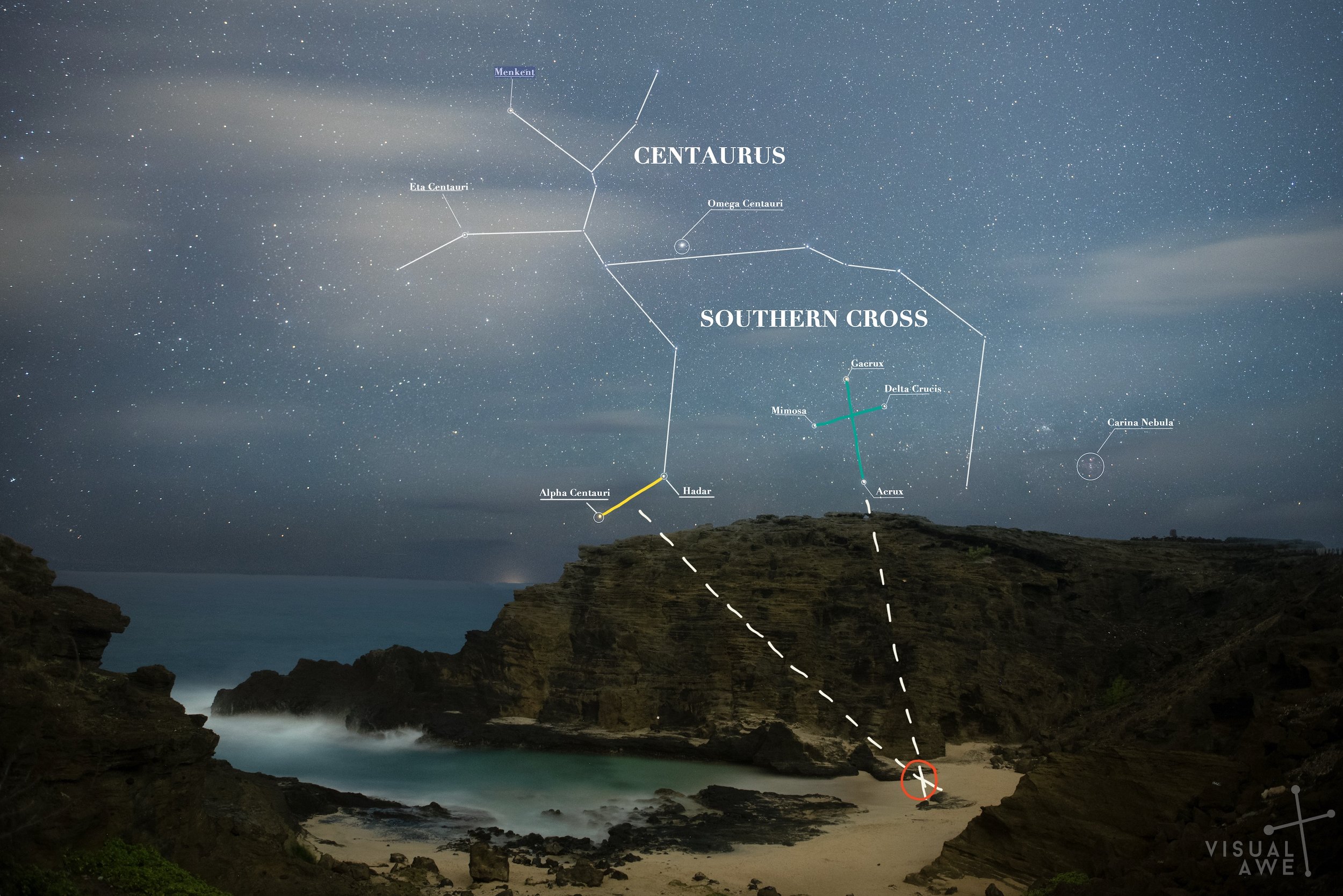
The image labeled, showing the Southern Cross (blue-green), the Pointers (yellow), and the imaginary lines drawn to the South Celestial Pole (white). The south celestial pole is circled in red.
Using the Southern Cross and the Pointers, you can see how navigators had to draw these imaginary lines to find the South Celestial pole. Now, the reason why “x marks the spot” (circled in red) is in the ground is because this photograph was taken in Hawaii, which is about 21º above the equator. In other words, I am in the Northern Hemisphere, while the south celestial pole is in the Southern Hemisphere. Because the Earth is a sphere, the Earth’s surface blocks my view from seeing the south celestial pole from this location.
Pointing to the Cross
This picture showcases such a perfect illustration of how the Gospel is central to our life. Here, the Southern Cross stands tall over the sea. Before the time of the GPS, navigators would look for the Southern Cross to help them navigate the Southern Hemisphere. Since the Southern Hemisphere does not have a “south star”, the Southern Cross was used because its base pointed toward the location where a “south star” would be if it existed.
Likewise, the Pointers were used to help navigators find the south celestial pole. Navigators would draw an imaginary line that bisected the Pointers. Where the two imaginary lines intersected would roughly mark the exact location of South, similar to how the North Star does for us today.
This is a great illustration for us today. The Cross is our guide in life, for Christ became our sin so we could become His righteousness if we repent and believe in Him. Through the Cross, we can come before His throne of grace and be reconciled with our holy God. The Cross leads us to our final destination we long for in our heart of hearts: being reconciled to God where we will be satisfied and made complete with Him.
Likewise, the Pointers also remind us of our need as Christians to point others toward the Cross. We need our lives to reflect Christ and His love for us, so that others can see and ask for the reason for the hope we have. As Peter writes, “But in your hearts set apart Christ as Lord. Always be prepared to give an answer to everyone who asks you to give the reason for the hope you have. But do this with gentleness and respect.” (1 Peter 3:15)
I think these things makes this picture extra special to me. It is a beautiful part of the Milkyway to observe and see with my own eyes, but the celestial reminder of the Cross of Calvary with The Pointers standing next to it, sets my heart on my God and Savior Jesus Christ. I pray this picture will stand as a reminder in your head to walk with the Lord with a whole heart, chasing after Him and being a “Pointer” to the people around you. My payer is you may be used by God to lead them to the hope we have in Jesus Christ: who became our sin, so we could become His righteousness in Him, if we believe in Him.